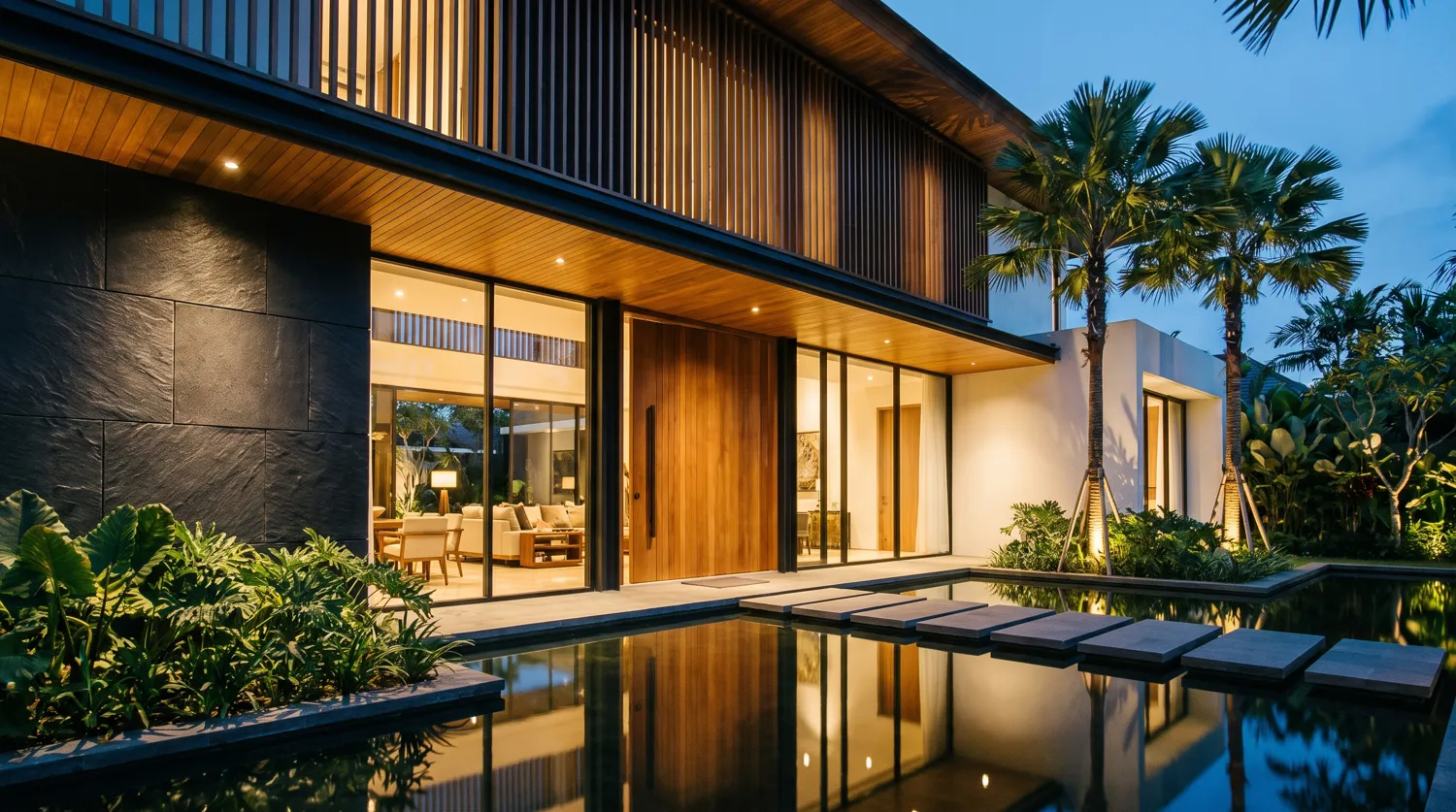
Waterproof facade materials for the rainy season
Why plaster and paint crack when the rains arrive, what 'waterproof' really means for a facade, and which cladding options hold up through Indonesia's wet season.
Why plaster and paint give up in the wet season
Most facade failures in Indonesia start the same way: water finds a way in, and the sun and the next storm finish the job. A hairline crack in the render, a gap around a window frame or a pinhole in a paint film is enough. Once moisture sits behind the surface, paint blisters and peels, white salt deposits (efflorescence) stain the wall, and the render loses its grip on the substrate.
The tropical weather cycle makes this worse. A wall is soaked by an afternoon downpour and baked by direct sun an hour later. That repeated wet-dry, hot-cool movement opens new cracks every season. Cement render and paint are thin, rigid skins over a porous background, and they cannot absorb that movement for long.
Warm, damp surfaces also feed algae and mould. Shaded elevations turn green or black first, long before the structure itself is at risk, and repainting only resets the clock.
What 'waterproof' should mean for a facade
The word is used loosely by suppliers and contractors. For an external wall it helps to split it into three separate questions:
- Does the material absorb water? A material that stays dry in its body has nothing to swell, stain or grow mould in.
- Is the protection only a coating? A paint or sealer on a porous body works until it is scratched, worn by UV or cracked by movement. After that, the whole wall is exposed.
- Where is the weak point? On most buildings it is not the middle of the panel but the joints, corners, openings and the bottom edge near the ground.
No cladding replaces good detailing. Even a very water-resistant skin needs a sound substrate, proper drainage at the base and sealed penetrations.
How common facade finishes behave in persistent rain
This is a general comparison of where each option tends to fail in a wet climate, not a ranking. Always check the exact product.
| Finish | Typical weak point when it rains for weeks | What to check |
|---|---|---|
| Cement render and paint | Hairline cracks, blistering paint, efflorescence, algae | Substrate moisture, crack control, repaint cycle |
| Natural stone | Porous types absorb water and stain; heavy, needs proper fixings | Stone type, sealing, fixing system |
| Porcelain or ceramic tile | Dense body, but joints and adhesive are the weak link; heavy | Joint quality, adhesive, substrate |
| Flexible ceramic (MCM) | Edges and joints if detailed carelessly | Adhesive, joint sealing, substrate preparation |
Notice that the weak point is rarely the face of the material. It is the interface: where the cladding meets the wall, the window or the ground.
Where flexible ceramic fits
Flexible ceramic, also sold as MCM, flexi stone or soft stone, is a 3-5 mm sheet made from natural stone powder and a modified mineral binder, with a factory hydrophobic treatment. The idea is to put a water-repellent mineral skin on the wall instead of relying on a coat of paint. The clay series is listed at 0.5% water absorption, and the surface is mould-resistant, so rain does not leave the wall damp and green.
Panels weigh 4-7 kg/m², so the cladding adds very little load, and they glue to concrete, brick, plaster or board. Because the sheet can be cut with a knife and wrapped around columns and curved walls, you can remove many of the joints where water would otherwise enter. For a broader comparison of options, read best facade materials for the tropical climate, and see the FAQ for installation and substrate questions.
Detailing that decides whether any facade stays dry
Whichever material you pick, these points decide the result more than the brochure does:
- Substrate first. Repair active cracks and let a wet wall dry before cladding. Cladding over a damp wall traps the problem.
- Keep the base clear. Bottom edges should not sit in standing water or take constant splash-back from soil, planters or pool decks.
- Seal joints and corners with a product suited to the panel and adhesive, following the supplier's guidance.
- Protect openings. Flash and seal around windows, doors and penetrations; add drip detail where water would run behind the cladding.
- Manage roof water. Overhangs, gutters and downpipes keep the heaviest flow away from the wall face.
Plan the work around the weather
The best time to clad is a dry spell, because adhesives and sealants need dry surfaces to bond and cure properly. If a project has to run through the rains, schedule exterior walls in the driest weeks, cover fresh work against sudden showers and keep material stored off the ground and out of the rain. Ordering samples and a project batch early gives you room to do this without rushing the substrate preparation, which is where most rainy-season problems actually begin.
For a retrofit, the same logic applies: inspect the wall after a heavy storm, note where it stays dark and wet, and fix those spots before anything is stuck on top. The installation guide covers the practical sequence.
A short checklist before you specify
- Ask for the water absorption data of the exact finish, not the product family.
- Ask what protects the surface: a body that repels water, or only a coating on top.
- Ask for installation guidance for your substrate and your climate zone.
- Request a sample and leave it outside for a few storms before you commit.
- Agree who is responsible for substrate preparation and joint sealing on site.
If you are planning a villa or a commercial block, the guide to flexible stone for villa facades shows how this applies on a real project.
FAQ
Is flexible ceramic suitable for facades that see months of rain?
Yes. It carries a factory hydrophobic treatment, is mould-resistant and UV-stable, and is rated for a 15-20 year service life. Correct substrate preparation and joint detailing are still essential.
Will waterproof paint solve a cracking plaster facade?
It can slow surface wetting, but it does not fix movement cracks or moisture already in the wall. Treat the substrate first, then choose a finish that does not depend on a thin film.
Do I still need a waterproofing layer behind the cladding?
Wall build-up and damp-proofing remain the project's responsibility. Send us your wall type and we will advise on the cladding side.
Planning for the next rainy season? Message us on WhatsApp to request samples and a wholesale price list, and test the finish on your own wall before ordering.
Keep reading
Flexible ceramic vs natural stone
How the thin, bendable panel compares to real stone and porcelain tile.
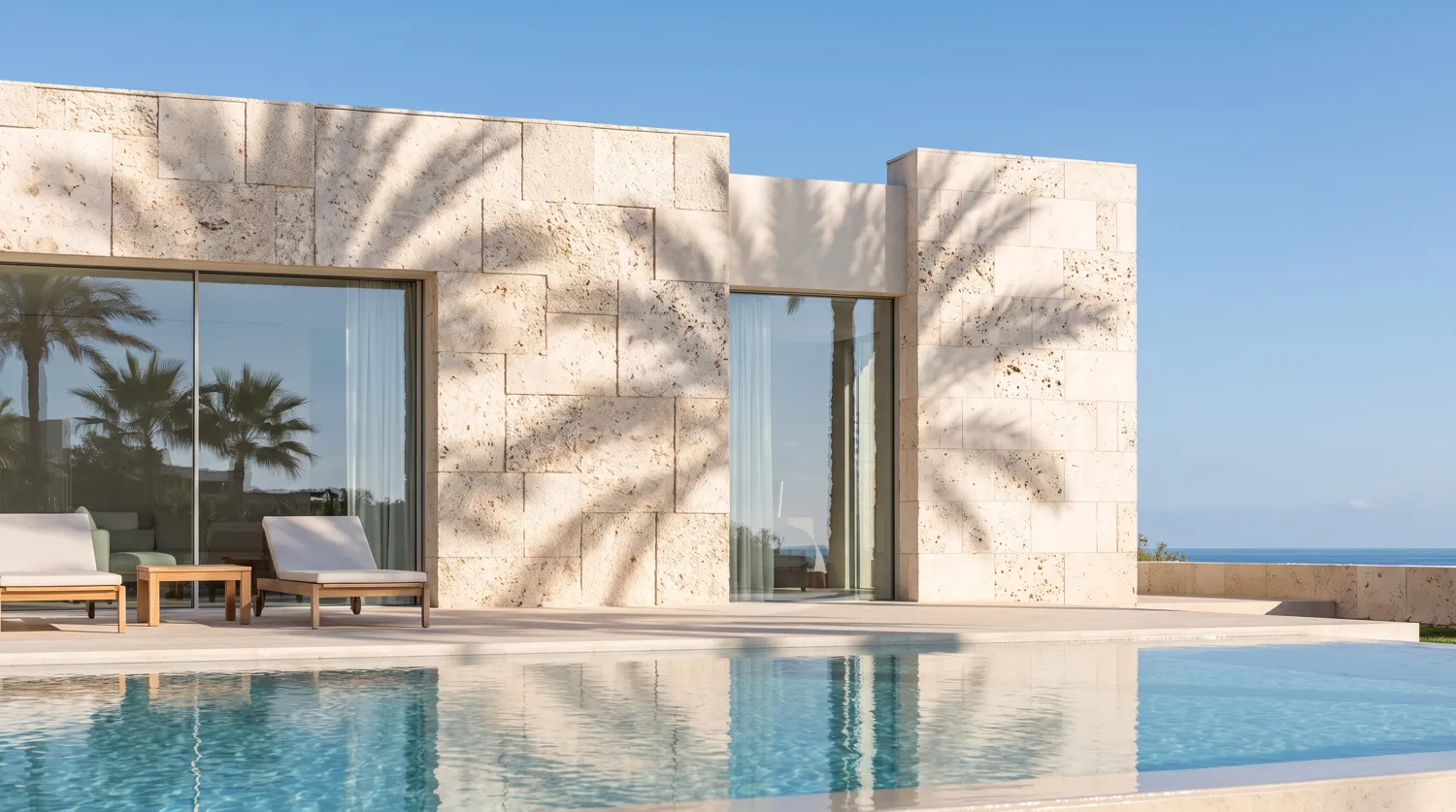
Best facade materials for the tropics
What survives humidity, salt air and UV in Bali and across Indonesia.
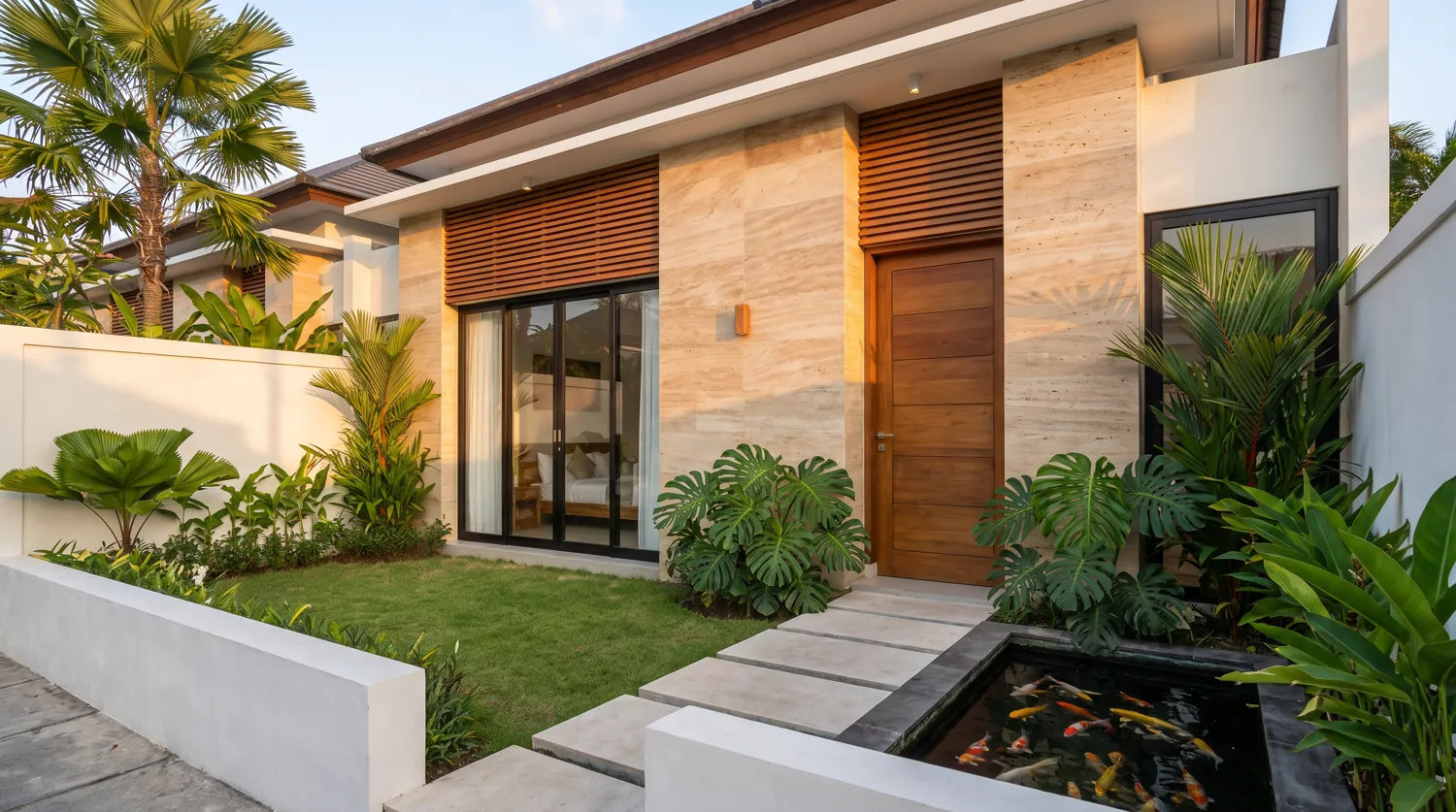
Flexible stone for villa facades
A practical guide for villa developers and architects in Bali.
Get free samples and a project quote
Send us your project — we'll match the right finish, calculate cost and support installation.